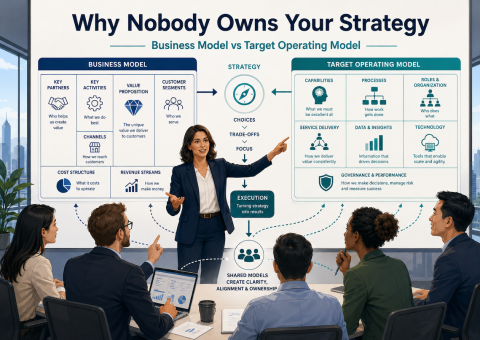
Why Nobody Owns Your Strategy — Even When Everyone Agrees With It
You present the strategy.
Everyone nods. ✅
The objectives seem clear.
The direction makes sense.
Nobody openly disagrees.
And yet, a few weeks later…
👉 Decisions are still bouncing between departments.
👉 Teams interpret the strategy differently.
👉 Nobody is quite sure who owns what.
👉 Projects start moving… but not necessarily in the same direction.
Sound familiar?
In my previous article, I looked at some of the bottlenecks that make strategy implementation harder than it needs to be.
One of the first symptoms is often lack of ownership.
But lack of ownership is not always a people problem.
Sometimes, people simply don’t have a sufficiently clear picture of what the strategy means for the business — and how the organization is supposed to deliver it.
That’s where two useful tools come in:
🔹 the Business Model
🔹 the Target Operating Model
They answer different questions.
The Business Model: How does the business create value?
A Business Model describes, at a high level:
Who do we create value for?
What value do we provide?
How do we create and deliver that value?
And how does the business make economic sense?
One of the best-known tools for making this visible is Alexander Osterwalder’s Business Model Canvas.
Its strength is its simplicity.
Nine blocks force a leadership team to look at the business as a whole:
1️⃣ Customer Segments
2️⃣ Value Propositions
3️⃣ Channels
4️⃣ Customer Relationships
5️⃣ Revenue Streams
6️⃣ Key Resources
7️⃣ Key Activities
8️⃣ Key Partners
9️⃣ Cost Structure
Nothing revolutionary when you look at the individual boxes.
But put them together on one page and something interesting happens.
Marketing sees how its choices affect Operations.
Operations sees how it supports the value proposition.
Finance sees the economics behind the model.
Technology, Procurement, Sales and other functions can see where they fit into the system.
💡 The conversation shifts from “my department” to “our business model.”
And that matters for ownership.
Because once the model is clear, you can start asking:
Who is accountable for making each part of this model work?
The Canvas can therefore become a useful starting point for an accountability discussion — and even for translating the model into a RACI or similar ownership map.
I started using the Business Model Canvas around 15 years ago, initially for my own business and startup projects.
I still find it particularly useful when a company is:
🚀 creating a new business
🔄 significantly changing how it creates value
🌍 entering a new market
💡 launching a fundamentally different proposition
But sometimes the business model itself is not really the issue.
The strategy may require the organization to operate differently.
Then another tool becomes more useful.
The Target Operating Model: How will we actually make this work?
Imagine the strategy says:
“We want to move from selling equipment to providing a maintenance service.”
The Business Model helps clarify the new value proposition, customers, revenues, partners and activities.
But employees still need answers to very practical questions.
Who delivers the service?
Which capabilities do we need?
Which processes must change?
Who owns the customer relationship?
What technology supports the service?
Where are decisions made?
How will performance be measured?
That is where a Target Operating Model — TOM — becomes powerful.
A TOM describes what the organization needs to look like and how it needs to operate to deliver the strategy.
Depending on the situation, it can bring together areas such as:
🎯 Strategic intent
👥 Customers & value
🧩 Capabilities
🔄 Processes & value streams
🧑🤝🧑 Organization, roles & accountabilities
🚚 Service delivery
📊 Data & insights
💻 Technology & applications
📈 Performance management & governance
🛠️ Transformation initiatives
The exact boxes matter less than the conversation they force.
Because now the strategy starts becoming tangible.
Instead of saying:
“We need to become more customer-centric.”
You can discuss what customer-centricity means for processes, roles, systems, decision rights and measures.
Instead of:
“Operations needs to support the new strategy.”
You can clarify how.
And this is where I believe Business Models and Target Operating Models can make a significant contribution to strategy implementation.
Not because another framework magically solves ownership problems.
But because it is difficult to take ownership of something you cannot clearly see.
A shared visual model gives stakeholders something concrete to challenge, refine and ultimately own.
And that leads to an interesting diagnostic question:
🤔 When people in your organization lack ownership of the strategy, is it really an accountability problem… or do they simply lack a shared picture of what they are supposed to build?
I’d be interested in your experience.
👇 Where does strategy become unclear in your organization: the business model, the operating model, or further down at the capability and process level?
If you would like to see an example of a Target Operating Model visual, write “TOM” in the comments and I’ll send you an example.
In the next article, I’ll go one level deeper:
👉 Which capabilities does the organization actually need to implement the strategy?
And after that, we’ll look at where many implementation bottlenecks become painfully visible:
the processes through which the work actually gets done.


