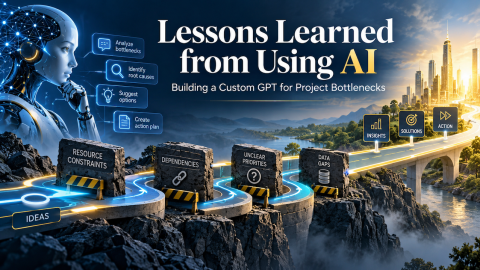
AI Is Brilliant. Until You Ask It to Follow a Process. 🤖
What building my own Custom GPT taught me about AI, automation, and the limits of technology.
AI can be an excellent thinking partner. It can challenge your assumptions, suggest creative solutions, and help you move much faster.
But what happens when you ask it to follow a precise process, consistently, from start to finish?
That's where things get interesting. 😅
Over the past few months, I've been developing a Project Bottleneck Quick Scan™, using a Custom GPT to help Project Managers identify the biggest bottleneck slowing down their projects and define a practical action plan to remove it.
The idea is simple.
When a project gets stuck, our attention is often drawn to the most visible symptoms rather than the real root causes.
And because projects are complex systems, different bottlenecks can be interconnected.
Fixing one problem may have little impact if another bottleneck is blocking progress further upstream.
My ambition was to use AI, combined with my Strategy Implementation Acceleration Framework™, to help Project Managers identify where to intervene first to make the biggest difference.
I thought developing the assessment would be the difficult part.
It turned out that making AI behave consistently and automating the process was at least as challenging! 😂
Here are some lessons I've learned along the way.
🎯 Lesson 1: AI can create value at three different levels
I've been using ChatGPT for quite some time, mainly in three ways.
✍️ 1. Tactical: Getting things done faster
Writing marketing emails, improving LinkedIn posts, developing email sequences, or finding a bridge between my business and a partner's offer.
I typically write a first draft myself and ask AI to make it clearer, more engaging, or more impactful.
The time savings can be significant.
But I still want the final content to sound like me, not like a generic AI-generated marketing message.
🧠 2. Strategic: Challenging my thinking
This is where things become more interesting.
I've been using ChatGPT to challenge my business strategy, analyse marketing campaign results, identify weaknesses, and develop new offers.
What struck me is how much better the insights become when you provide a solid framework.
AI doesn't replace strategic thinking.
But when you combine it with your own experience and a structured approach, it can help you explore options you might otherwise overlook.
⚙️ 3. Operational: Automating a complete process
This is where my Quick Scan project comes in.
The idea was to guide someone through a structured self-assessment, identify the most critical bottleneck, and generate relevant recommendations.
The initial results were surprisingly good!
But capturing the nuances of a real conversation turned out to be much harder.
Sometimes you need to ask another question. Sometimes an answer needs clarification. And sometimes the real issue is not the one the person initially describes.
This is where I believe human experience and intuition remain essential.
That's why my Quick Scan offers a follow-up conversation to validate the findings, challenge assumptions, and develop a focused action plan.
AI provides a useful starting point. Human judgement helps turn it into meaningful action.
🤖 Lesson 2: Creativity and predictability don't always go hand in hand
Here comes one of my biggest frustrations.
ChatGPT doesn't always follow instructions precisely.
You give it a sequence of steps. You test it. It works.
Then you run another test.
And suddenly it decides to do something slightly different! 😅
Now, that's not necessarily bad.
When using AI as a strategic sparring partner, I actually like it when it explores unexpected directions.
It can generate valuable insights.
But when you're building a repeatable process, that's a different story.
You need more predictable results.
For my Quick Scan, I wanted each user to go through a consistent assessment, while still allowing room to explore important nuances.
The challenge is finding the right balance between AI's probabilistic nature and the deterministic behaviour required by a controlled process.
So, how did I approach this?
Interestingly, I asked ChatGPT itself!
I asked it to analyse where it had deviated from the process and suggest improvements to its own instructions.
And that worked reasonably well.
I also learned that relying too heavily on instructions scattered across reference files could make the behaviour less reliable in my tests.
Keeping the critical process instructions directly inside the Custom GPT configuration helped, although the instruction-length limit forced me to prioritise what really mattered.
A familiar project management lesson, isn't it?
If you want reliable execution, you need clear requirements, a well-defined process, and continuous testing.
Even then, AI doesn't offer the same guarantees as traditional software.
🔐 Lesson 3: Connecting AI to other applications is not as simple as it sounds
Once the assessment worked, I wanted to automate the next step.
Send the results to the user by email.
Send myself a copy so I could prepare for the follow-up conversation.
And eventually use the feedback to improve the assessment.
Sounds straightforward, right?
Well… not quite! 🙄
My first concern was security.
Some available integrations appeared to require broader access to my data than I was comfortable granting.
I didn't want an automation to have unnecessary permission to read, delete, publish, or send information on my behalf.
So I started experimenting with Zapier as an intermediary between ChatGPT and other applications.
This allowed me to design a workflow with more specific controls and approval steps.
But that introduced another challenge.
💸 Lesson 4: The real cost of AI is not just the subscription
Suddenly, what seemed like a simple automation required:
- Multiple applications communicating with each other.
- Several steps combining AI and traditional automation.
- Testing, troubleshooting, and maintaining the connections.
- Potentially additional paid subscriptions.
And the list keeps growing.
I don't know about you, but I'm already spending a significant amount on software licences.
It's tempting to subscribe to another tool whenever you discover a promising new feature.
But each additional application introduces costs, complexity, and dependencies.
And, of course, another learning curve.
As someone who has spent years helping organisations simplify processes and improve execution, I find the irony rather amusing.
I'm trying to build a tool that removes bottlenecks… while creating a few new ones for myself! 😂
🛠️ Lesson 5: When should you stop experimenting and start delegating?
At some point, I asked myself an important question.
Should I continue building and troubleshooting these automations myself, or outsource the technical work?
For now, I've chosen to continue experimenting.
Not because I particularly enjoy debugging integrations.
But because I believe that, before delegating something, it helps to understand what you're delegating.
What outcome do you need?
What are the technical constraints?
What is realistic?
And what should it reasonably cost?
There's also another reason.
I want to understand AI's practical capabilities and limitations firsthand, rather than relying exclusively on what others say it can do.
However, I don't intend to become a full-time AI automation specialist.
There's a point where learning creates value and a point where it becomes a distraction from your real business.
Knowing where to draw that line is another important lesson.
🚀 What's next? ChatGPT versus Claude
I'm now starting to experiment with Claude.
Not because I've concluded that one platform is better than the other, but because I want to understand which one works best for my needs.
I'll compare them across the three areas that matter most to me:
🎯 Tactical: How well do they help me execute everyday tasks?
🧠 Strategic: How effectively do they challenge my thinking and generate useful insights?
⚙️ Operational: How reliably can they support structured processes and automation?
I'm curious to see whether the differences are meaningful.
And I'll share what I learn.
💡 My biggest takeaway so far
AI is an incredibly powerful tool.
But its real value doesn't come from using AI everywhere.
It comes from knowing where AI adds value, where structured processes are necessary, and where human judgement remains indispensable.
In many ways, this isn't so different from managing a project.
You need clarity on the outcome, the right tools, well-designed processes, and people who can make sound decisions when reality doesn't follow the plan.
Technology can accelerate execution.
But it doesn't automatically guarantee the right outcome.
And sometimes, adding more technology simply creates more complexity.
The objective shouldn't be to automate everything. It should be to create more value with less effort and friction.
That's the principle I'll keep applying as I continue experimenting.
💬 Over to you!
I'm sure many of you are experimenting with AI too.
What's the most valuable lesson you've learned from using AI so far — a breakthrough, a frustration, or perhaps an unexpected surprise?
I'd love to hear your experiences in the comments. 👇
P.S. Curious to see what I've been building?
You can try my free Project Bottleneck Quick Scan™ to identify what's really slowing down your current project and get a first action plan to address it.
👉 Discover your biggest project bottleneck


