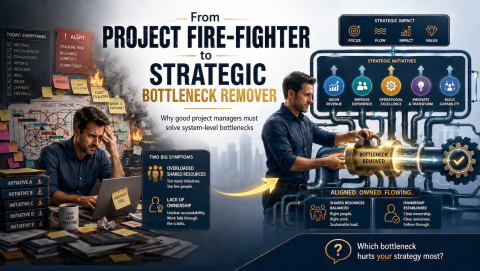
Why good project managers still end up fighting fires
In the next editions of this newsletter, I want to explore a shift that matters more than most project management methods.
The shift from being a project fire-fighter to becoming a strategic bottleneck remover. 🎯
A competent project manager already does many things right.
The project definition is aligned with stakeholders.
The plan is built with the people who will do the work.
Execution is clear, responsibilities are understood, and deviations are addressed early.
That is project management discipline.
It is the necessary hygiene that gives a project a real chance of succeeding.
But only if everything around the project also works.
And that is where things become interesting.
Projects rarely fail because of the plan alone
Projects are delivered by people.
So yes, team dynamics, stakeholder resistance and change fatigue matter.
Good project managers deal with those issues as well.
But sometimes the real problem sits above the project.
It is built into the way the organization chooses priorities, allocates capacity, defines ownership and connects strategy to day-to-day work.
When that happens, even a very strong project manager can spend most of the week solving the same problems again and again.
Two symptoms appear in many strategic initiatives.
The first is critical shared resource overload.
The same experts are assigned to several projects, operational work remains untouched, and every initiative is expected to move at full speed.
The second is lack of ownership.
People focus on keeping operations running and see strategy execution as somebody else’s responsibility.
These symptoms are visible.
The bottlenecks behind them are often less visible.
Why are critical resources overloaded?
Usually because too many initiatives are running at the same time.
And that often happens because priorities are unclear, unstable or disconnected from real capacity.
Several bottlenecks may be at work.
1. Weak alignment between strategy and initiatives
It is not always clear how strongly each initiative supports the strategic priorities.
As a result, every sponsor argues that their project is essential.
The executive team needs one shared view of which initiatives matter most and why.
Without that alignment, the organization receives mixed messages.
2. Unclear dependencies between projects
Initiatives rarely exist in isolation.
One project may depend on a process, system, decision or capability that another project is supposed to deliver.
When these dependencies are not understood, the sequence is wrong, rework increases and teams create friction for one another.
3. Competing operational and strategic objectives
Departments are often measured on short-term operational performance while being asked to contribute to long-term transversal change.
That creates a predictable tension.
People support the strategy in principle, but their KPIs reward them for protecting today’s results.
4. Capacity is not enough taken into account
Ambition is approved before capacity is understood.
Nobody defines how many projects a role can realistically support.
And the issue is not only the number of people available.
The organization also needs to understand whether the required skills are available at the right time.
Multitasking works up to a point.
Beyond that point, productivity drops and noise takes over. ⚠️
Why is ownership missing?
Sometimes people do not resist the strategy.
They simply do not understand it well enough to act on it.
The strategic goal may be clear, but the concrete path remains vague.
5. An unclear business model or target operating model
A strategy should explain more than where the organization wants to go.
It should clarify how value will be created and how the organization will operate differently.
Without that picture, teams struggle to understand what must actually change.
6. Unclear performance levers
Organizations often launch improvement work across the whole value chain without agreeing on the few constraints that most affect performance.
Activity increases, but impact remains scattered.
The better question is not, “Where can we improve?”
It is, “Which bottleneck should we remove first?”
7. A roadmap nobody trusts
Frequent priority changes, repeated reallocations and stop-and-go decisions create wasted energy.
Eventually, people stop believing that the latest plan will last.
Markets change, of course.
But not every roadmap change is caused by the market.
Some come from unresolved departmental priorities, conflicting KPIs or poorly understood dependencies.
8. No visible link between short-term work and the long-term direction
Teams need to see how the next step fits into the bigger picture.
When that link is missing, hesitation grows.
People become cautious because they do not know whether today’s effort will still matter tomorrow.
9. Weak communication of priorities and mandate
Sometimes what looks like resistance is simply confusion.
Who is expected to lead?
Who must contribute?
Which work takes priority when operations and strategic projects compete?
When leadership leaves those questions open, people answer them according to their own interests and pressures.
The project manager’s role can be bigger
Project managers cannot solve every organizational bottleneck alone.
But they can make them visible.
They can work with executives, line managers, business architects and PMOs to clarify priorities, dependencies, capacity, ownership and sequencing.
That may not appear in the official job description.
It can still be the work that creates the most value.
This is how a project manager stops fighting the same fires and starts improving the system that keeps creating them.
Which of these bottlenecks causes the most damage in your organization today?
And which important bottleneck would you add to the list?
In the next edition, I will take them one by one and explore what project managers can realistically do about them.
Take care,
Nicolas


