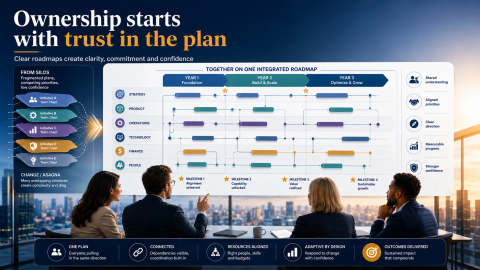
People won’t take ownership of a plan they don’t trust.
And one of the fastest ways to destroy that trust?
👉 Constantly changing the plan.
I’ve seen this many times.
A company has a clear strategic direction.
Individual projects are launched.
Departments build their own roadmaps.
Portfolio management prioritizes initiatives.
Everything looks reasonably structured.
But there’s one problem:
Nobody has put the pieces together. 🧩
One department assumes a capability will be available in March.
Another department plans to deliver it in September.
A program depends on a system that isn’t ready yet.
Three major changes hit the same business team at exactly the same time.
Welcome to what I sometimes call the “change lasagna.” 🍝
Layer upon layer of initiatives… each one making sense individually, but creating a mess when stacked together.
And then the inevitable happens:
🔄 Plans are revised.
🔥 Teams start firefighting.
😤 People get frustrated.
📉 Confidence in management’s plans decreases.
Eventually, employees stop really committing.
Because why reorganize your work around a plan you expect to change again next month?
This is why I believe organizations need more than a collection of project plans.
They need a clear, integrated portfolio or program roadmap showing:
✅ Major initiatives
✅ Dependencies between them
✅ Resource constraints
✅ Key decision points
✅ Capabilities that must be built
✅ Short-term AND longer-term objectives
Ideally, the roadmap should look 2–3 years ahead.
Not because we can predict the future.
We obviously can’t.
But because people need to understand the direction of travel — and management needs to see whether the transformation is actually achievable.
There’s another benefit that is often underestimated:
Communication becomes much better. 📣
I once saw a CEO explain very openly why certain priorities had been chosen and walk employees through the high-level roadmap.
There were significant changes ahead, including potential impacts on some departments.
Yet the transparency was highly appreciated.
People didn’t necessarily like every change.
But they understood why it was happening and where the organization was going.
That makes a huge difference.
Too often, strategy communication remains something like:
“We will become more customer-centric, agile and digitally enabled.”
Great.
But the employee listening is thinking:
“What does that actually mean for me?” 🤔
A good roadmap creates the bridge between strategy and that question.
The CEO can explain the big picture.
Directors can explain what it means for their departments.
Managers can explain the next layer.
And employees can finally understand what might change in their day-to-day work.
There is one final piece:
Make ownership visible.
Business Models and Target Operating Models can clarify responsibilities at organizational level.
But people also need to know:
👉 Who is responsible for what?
👉 Who can make which decisions?
👉 Who should I speak to if I see a problem?
👉 Who can I contact if I want to contribute?
That’s when “ownership” stops being a vague management expectation and starts becoming something practical.
Building an integrated roadmap takes time.
But so does rework. 😉
And in my experience, a stable, understandable and transparent plan is one of the foundations for getting people to trust the strategy — and take ownership of delivering it.
💬 How does your organization manage this today?
Do you have one integrated roadmap across the business — or mostly a collection of departmental and project roadmaps?
I’d be interested to hear what works (or doesn’t) in your organization.


